Dangerous roadside trees – the hidden Autumn risk for Scotland’s motorcyclists
As of 1 September 2026, the Met Office has revealed its new list of
storm names for the 2026/27 season. It is an annual announcement that signals more than the changing seasons. For Scotland’s motorcyclists, the arrival of autumn brings darker journeys, stronger winds, debris on the road and another potentially serious hazard: dangerous roadside trees.
Scotland enters another storm season
On 23 September 2026, the sun will cross the celestial equator heading south in what is known as the September Equinox, marking the official start of autumn in the Northern Hemisphere. Since the summer solstice on 21 June, daylight hours have been steadily shortening, culminating in the winter solstice on 21 December when Scotland will experience its shortest day of the year.
With darker mornings, earlier sunsets, stronger winds, and increasingly severe weather comes a very real warning for vulnerable road users across Scotland.
Why fallen trees pose a particular danger to motorcyclists
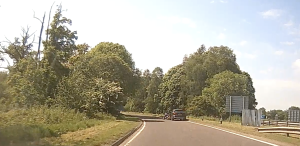
Scotland boasts thousands of miles of spectacular rural roads, winding through forests, glens, and country estates. In good weather, these routes are a pleasure to ride. However, many of these roads are lined with mature woodland and aging trees that have been exposed to decades of harsh Scottish weather.
Over time, trees can become dangerous due to factors such as disease, storm damage, obstructed view at junctions, and a failure to carry out adequate inspection and maintenance.
When a tree or large branch fails, the consequences can be devastating.
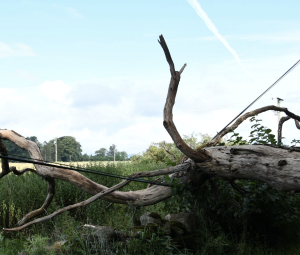
A falling tree may strike a moving vehicle directly, cause a rider to take evasive action, obstruct emergency services, or completely block a carriageway. Any of these scenarios can result in serious injury or death.
For motorcyclists, the risks are particularly acute.
Unlike occupants of cars, riders have virtually no physical protection. What may amount to a relatively minor collision for a driver can prove fatal for a motorcyclist. Many rural roads are also subject to the national speed limit, meaning reaction times are limited and opportunities to avoid a sudden obstruction are often non-existent.
Harry’s story: the devastating consequences of a fallen tree
We have previously shared the tragic story of Harry, which can be read
here.
Harry was simply travelling to work on a route he knew well. It was an ordinary journey on an ordinary day when he encountered a fallen tree lying across the carriageway. Despite doing nothing wrong, Harry suffered fatal injuries and died at the scene.
We continue to fight for answers, accountability, and justice for Harry and his family, whilst working to ensure that no other rider suffers the same fate.
The law places obligations upon both landowners and public authorities to address foreseeable dangers.
Who is responsible for dangerous roadside trees in Scotland?
Under the Occupiers’ Liability (Scotland) Act 1960, occupiers of land owe a duty to take reasonable care to ensure that people do not suffer injury or damage as a result of dangers arising from the state of their premises.
Case law such as Parker v National Trust [2021] EWHC 1589 (QB), highlight the importance of having an appropriate system for the inspection and management of potentially hazardous trees.
In addition, section 91 of the Roads (Scotland) Act 1984 gives roads authorities powers to require landowners to address trees and vegetation that endanger road users, obstruct visibility, or are likely to fall onto a road. Where a danger is considered imminent, roads authorities may carry out the necessary works themselves.
What warning signs can indicate a dangerous tree?
Dangerous trees rarely become dangerous overnight. In many cases there are warning signs such as visible decay, dead branches, fungal growth, leaning trunks, root movement, or previous storm damage. The crucial question following any serious collision is often whether the danger ought reasonably to have been identified and addressed before somebody was injured.
How motorcyclists can reduce the risk this autumn
Whilst riders cannot control the condition of roadside trees, they can take steps to reduce their risk.
•Expect debris after storms and periods of high winds.
•Look well ahead for signs of fallen branches, forestry activity, or stationary vehicles.
•Reduce your speed, particularly on unfamiliar or tree-lined rural roads.
•Report dangerous trees to the local authority, FixMyStreet, or Police Scotland if there is an immediate danger.
Scotland’s tree-lined roads are among the most beautiful riding routes in the world. However, preserving their beauty must never come at the expense of public safety.
Roadside tree safety is everyone’s responsibility
Landowners, roads authorities, and contractors all have an important role to play in identifying and managing dangerous trees before tragedy strikes.
Motorcyclists, meanwhile, must remain vigilant, particularly as autumn approaches and Scotland enters another storm season.