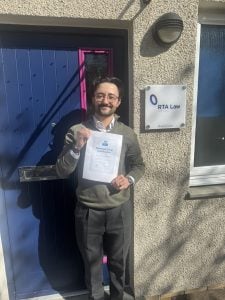
As a trainee solicitor with RTA Law, I represent car drivers, cyclists and motorcyclists who have been injured on Scotland’s road. I am also an avid cyclist, so I know what it feels like to be a vulnerable road user.
I would have considered myself a safe driver, however, I also realise that driving a car is a privilege that should be treated accordingly.
Since starting my traineeship, I have become so much more aware of the dangers on the road. When you are in a car, you have a degree of protection that is not afforded to vulnerable road users. Due to this, drivers owe a heightened duty of care to more vulnerable road users, such as pedestrians, cyclists, motorcyclists, and horse riders. In recognition of this responsibility, I wanted to learn how to better observe, anticipate, and plan to ensure that I am driving in the safest possible manner for other road users.
I signed up to the Advanced Driver course with IAM RoadSmart through the Borders Group of Advanced Motorists (BGAM). I was quite nervous to start. The longer you have been driving, the bigger the potential that you have picked up some bad habits along the way. I met my Observer, Fraser Brydon, at a local café. We discussed the basics; what would be expected of me, and the expected timeline of the lessons. We busted some misconceptions about what it meant to be a safe driver. There is a common misconception that a safe driver is one that is able to react quickly. Whilst this might be true if a completely unforeseen hazard presents itself, I soon learnt that a safe driver is actually one that proactively plans ahead to limit the need for reactiveness.
After this initial meeting, my observer and I would head out in my car. We met every few weeks to complete observed drives. Each week, after our lessons, Fraser would draw my attention to areas of the Highway Code, online resources, or sections of the IAM course handbook for me to read in anticipation of our next drive. Then, come the next drive, I would have built them into my driving, gradually building up a comprehensive toolkit of skills.
The lessons tackled key parts of driving such as cornering, overtaking, and roundabouts. A core part of Advanced Driving is planning. In order to do this, you should be able to narrate what you see, your decision-making process, and how that is going to affect your driving. This narration, or ‘spoken thoughts’, felt so alien at first. However, I was soon saying ‘in the far distance I see….’ like I had been doing it for years!
Getting used to looking ahead at the furthest possible distance and then working back, was a lot to learn when you are driving up to 60mph. However, the more lessons I had with Fraser, the better I got at pre-emptive planning. During the course of my lessons, I began to worry less when I was in the car because I was not just observing all the relevant information but also searching for information that I could not yet see and translating that into what that would mean for my driving.
I especially enjoyed developing the skill of appropriate road positioning and smooth cornering. I live in an area of the Scottish Borders where there are plenty of twists and turns in the road. Before embarking on my Advanced Driving journey, I would often find myself panicking and adjusting speed too close to a corner because I had not adequately prepared for it beforehand. I was pleasantly surprised at how easy it is to prepare for a corner through things like adjusting speed well in advance, positioning to maximise view, and the application of positive power through the corner.
After just a handful of sessions Fraser encouraged me to book my Advanced Driving test. On the of the test morning, that nervous energy returned. I met Fraser early and we went out for a final drive. I then went out for my test drive with the examiner which took less than an hour. Tense silence filled the car as I parked up and not 5 minutes later the examiner was telling me that I had passed with a F1RST! I was ecstatic!
Throughout the course of my lessons Fraser was incredibly encouraging and worked with me to maximise my understanding. The thing to remember is that, unlike the initial driving lessons and test, Advanced Driving is not compulsory. Whenever I would find myself overwhelmed, my observer gently reminded me that the end goal for every observer is to support someone to achieve a pass or a F1RST, not to grill or interrogate!
I now feel so much more confident when driving and I am now so much more aware of poor driving. To all those who feel like there is nothing more to be learned about driving, I would definitely recommend IAM Advanced Driver training. I would like to thank Fraser for being an excellent teacher and RTA Law for supporting me in pursuit of my Advanced Driving qualification.
Reuben Jarvis
Related Articles

RTA LAW promotes Jack Adair to Associate
RTA Law LLP is delighted to announce the promotion of Jack Adair to Associate Solicitor, recognising his contribution to the firm, legal expertise and commitment to helping vulnerable road users.

What should we do with e-scooters? It’s time to end the legal grey area
E-scooters are becoming increasingly common on Scotland's roads and pavements, yet privately owned models remain illegal to ride in public. With accidents rising and compensation claims exceeding £110 million, is

Is Artificial Intelligence causing a crisis in legal instructions?
Artificial intelligence tools such as ChatGPT, Claude and Gemini are increasingly influencing how clients communicate with their solicitors. While AI offers significant efficiencies, recent cases involving fabricated legal authorities highlight
Is it worth 5 minutes of your time?
A quick phone call allows us to ask you a few questions about what happened to you and determine whether we can help.
This form collects your name and phone number so that we can contact you. Check out our Privacy Policy for more detail on how we store, process and protect your submitted data. If you choose not to consent, please use an alternative contact method shown on our Contact page.