Case background
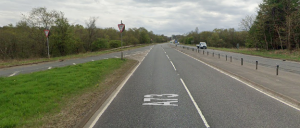
On the 22nd of January 2021, Steven Lyons was being driven by his work colleague, Mr Tortolano in a van insured by the defenders, QBE, an insurance company.
Whilst travelling south heading towards Airdrie on the A73, Stirling Road approaching Rigg End at approximately 70mph, Mr Tortolano noticed a car travelling in lane one ahead of them. The car was a Vauxhall Astra driven by Lauren Sands, an off-duty police officer and travelling between 65mph to 70mph.
Mr Tortolano decided to move into the right-hand lane, lane 2, to overtake Ms Sands. Ahead of both vehicles was a slip road to the left. An ambulance was travelling up the slip road with blue lights flashing and its sirens operating. It stopped at the junction when both drivers were approximately 100 metres away. A short distance beyond the A73 southbound, the road ceases to be a dual carriageway. Mr Tortolano did not slow down upon seeing the ambulance at the slip road. As the drivers approached, Ms Sands moved from lane 1 to lane 2 at a point 50m prior to the slip road. She did not signal right. The front of Tortolano’s van collided with the rear of Sands’ car and, in the collision, Steven Lyons was injured.
Court proceedings and judgement
An action was raised in the All-Scotland Personal Injury Court at Edinburgh. At the hearing on 12 March 2025, the Sheriff found that Mr Tortolano and Ms Sands had both made a material contribution to the collision. Mr Tortolano should have altered his speed to stay behind Ms Sands in the presence of the ambulance that created a change in the traffic circumstances. Ms Sands should not have moved to the right without signalling and that was negligent. Both drivers were travelling too fast for the approaching end of dual carriageway.
Key legal principles | Passenger injury claims
Steven Lyons was awarded compensation for his injuries because the actions of Mr Tortolano made a material contribution to the collision. There was no requirement to apportion blame between either of the drivers as Mr Lyons was an innocent victim. He recovered damages in full from the insurer of the van.
This case highlights the different duties that road users owe to one another and that drivers can often be equally blameworthy, depending on the circumstances. This case highlights the legal principle that multiple road users can share blame, even if only one is sued, if they each materially contribute to a collision.
Lessons for road users
The case also highlights the duty to anticipate emergency situations and developing hazards and to adopt defensive, as opposed to aggressive, driving techniques. It emphasises the importance of mirror, signal, manoeuvre, before committing to a lane change and the overall duty on all road users not to exceed the appropriate speed for the road and traffic conditions, which may be different to the posted speed limit.
You can find the full Judgement here.
Related Articles
MW v Wilkinson – Driver not liable in child pedestrian accident
A tragic road traffic accident involving a 5-year-old boy resulted in serious injuries, but the court found the driver was not liable. This case highlights when drivers may – and
Atkinson v Kennedy – Driver not liable in child pedestrian case
Atkinson v Kennedy demonstrates that even in serious child pedestrian accidents, liability is not automatic. The Court held the collision was unavoidable despite the driver exceeding the speed limit.
Gadsby v Hayes | Child pedestrian toucan crossing case
A High Court case examining whether a driver should reduce speed to 10 mph at a toucan crossing. Despite serious injuries to a child pedestrian, the court found no negligence.
Is it worth 5 minutes of your time?
A quick phone call allows us to ask you a few questions about what happened to you and determine whether we can help.
This form collects your name and phone number so that we can contact you. Check out our Privacy Policy for more detail on how we store, process and protect your submitted data. If you choose not to consent, please use an alternative contact method shown on our Contact page.