Car emerges into motorcyclist’s path on Liberton Road
At around midday on a Wednesday in mid June, our client was riding his Honda CBR 650cc motorcycle in a Northerly direction on the A701 Liberton Road, Edinburgh. Liberton Road is subject to a speed limit of 30 mph.
Approximately, 110 metres North of the junction of Liberton Road, Mayfield Road and Braefoot Terrace, a car suddenly pulled into our client’s path from a side junction to his right. Our client was unable to avoid a collision and was thrown approximately 25 metres into two passing pedestrians.
Due to his significant injuries our client was unable to remember the collision or the moments leading up to it. He was charged with careless driving and on advice pled guilty to travelling at 40 mph in a 30 mph zone. He was fined £470 and had penalty points endorsed on his licence. The Sheriff in the criminal trial accepted culpability should have been shared but the driver was never charged.
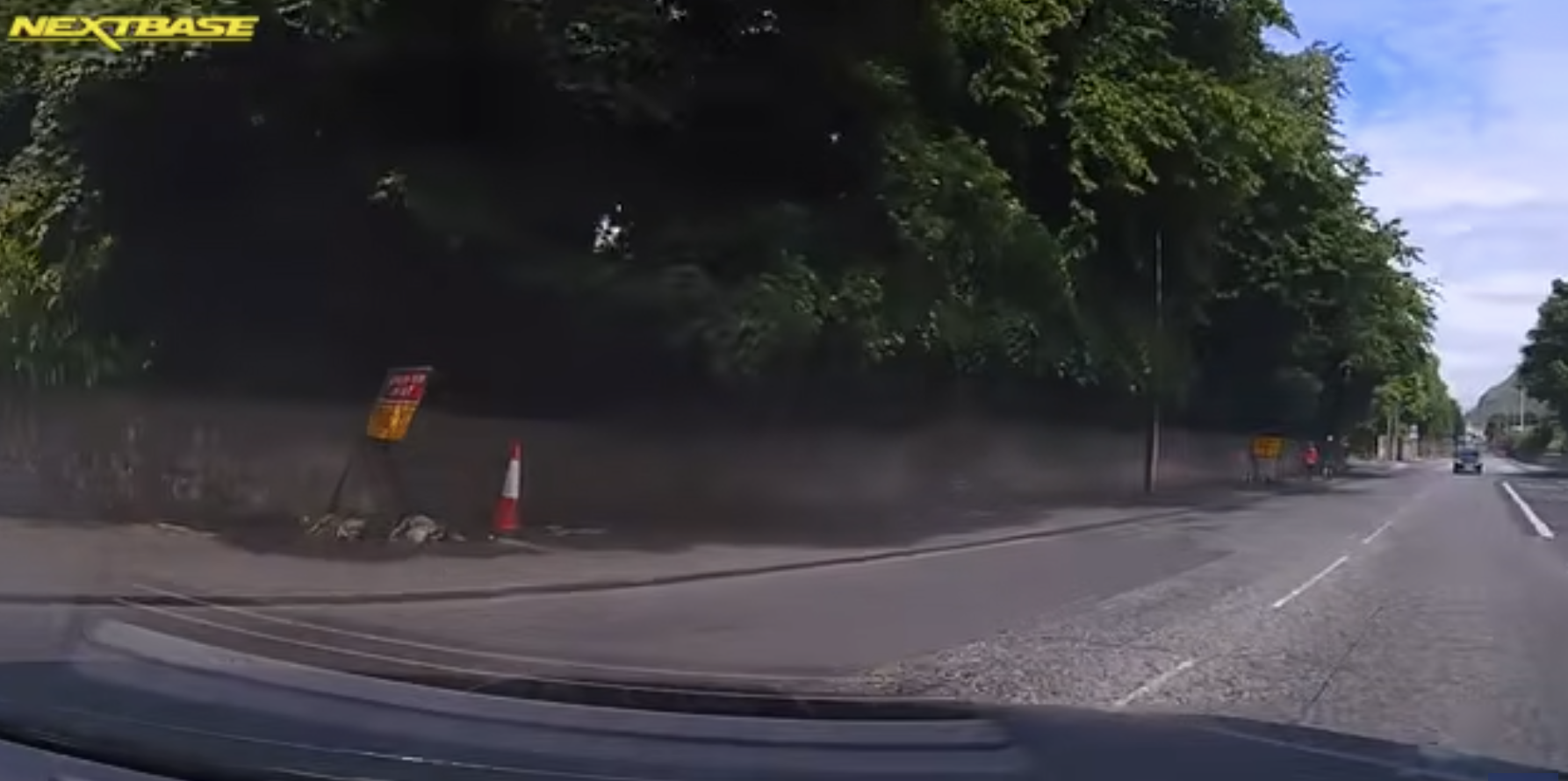
We were able to acquire dashcam footage which can be viewed opposite.
For his civil case ,we set about collecting witness statements from a range of pedestrians, the driver, and the Police that attended.
Some witnesses alleged that our client was travelling at more than twice the speed limit, whereas others were unable to estimate what speed he was going. Ultimately, it was determined in his criminal case that our client had been travelling at a speed of 40 mph based on an interpretation of the dashcam footage.
Insurer denies liability and blames motorcyclist’s speed
Following intimation of the claim for compensation, the third-party insurer originally denied liability. It was their initial position that their driver had been edging out slowly, looking both ways, and that our client’s speed was the sole cause of the accident.
Many viewers may form their own opinions as to what the footage shows and who is at fault. However, it will be seen that, in contrast to the initial position, the car emerged in one continuous movement, through queuing traffic on their left that was impeding their view, instead of edging out.
Our client recognised that he was travelling too fast for the conditions and was prepared to accept his share of responsibility for the collision. However, this does not mean that the driver was not negligent.
It is important to highlight that criminal law is separate from the law of negligence. Excessive speed does not necessarily relieve the turning driver of responsibility for checking for other road users, especially vulnerable ones. The conviction for careless driving translates to an inference he was negligent in civil law.
Highway code, case law and contributory negligence
The Highway Code places clear responsibilities on drivers emerging from junctions to ensure it is safe before commencing their manoeuvre.
Rule 170 requires drivers at junctions to take extra care, including looking all around before emerging and watching for road users who may be harder to see, including motorcyclists.
Rule 211 specifically warns that motorcycles can be difficult to judge and may be approaching faster than expected. Drivers are advised to look carefully before emerging or turning and to give way where necessary.
The Highway Code was updated in 2022 to emphasise the concept of the Hierarchy of Road Users.
Rule H1 recognises that those in charge of vehicles capable of causing the greatest harm have the greatest responsibility to reduce the danger they pose to others. Motorcyclists are specifically recognised as vulnerable road users because they have little physical protection in a collision.
Rule 204 reinforces this principle by reminding drivers that motorcyclists are among those most likely to suffer serious injury and that motorists should take particular care around them.
The Hierarchy of Road Users does not give motorcyclists priority or excuse riding at an inappropriate or excessive speed. All road users remain responsible for their own actions.
However, the Highway Code recognises that those in charge of vehicles capable of causing the greatest harm bear the greatest responsibility to reduce the danger they pose to others.
When emerging from a junction, drivers must therefore take particular care to look out for vulnerable road users, including motorcyclists, and ensure that it is safe before entering their path.
These principles are reflected in the case of Jones v Lawton, a case where the motorcyclist required an above knee amputation following a collision with a car that emerged from a junction into his path. At the time, the motorcyclist was “filtering” at 30 mph up the offside of two lanes of stationary traffic and a gap had been left for the driver to turn right out of the junction. The Judge determined the driver created a hazard by crossing the path of the motorcyclist and the motorcyclist was a vulnerable road user. It was decided on a split liability basis of two thirds, one third in favour of the motorcyclist.
The case of Hernandez v Acar follows this same principle. The motorcyclist was found to be doing 50 mph in a 30 mph zone when a driver emerged from a junction to his left. There was fault on both sides but the balance shifted in favour of the motorcyclist because he was a vulnerable road user. Result 60/40 in favour of the motorcyclist.
Generally, a driver turning or emerging across the path of a motorcycle can bear significant responsibility because they are moving across another vehicle’s established line of travel and are in control of a heavier vehicle capable of causing greater harm.
This is relevant to what the courts describe as causative potency – the relative capacity of each party’s actions to cause the collision and resulting damage.
If there is any doubt about an approaching vehicle’s speed or position, the safer course is to wait.

Split liability settlement following serious motorcycle injuries
As a result of the collision, our client sustained multiple fractures across his body, internal injuries and a degloving injury to his right knee. He was placed into a medically induced coma and required multiple surgeries.
He now lives with ongoing cognitive restrictions and has a permanent deformity to his right leg. These significant injuries demonstrate the potentially devastating consequences when a motorcycle and car collide.
Our client’s claim eventually settled on a split liability basis, reflecting the respective actions of both parties and their contribution to the collision.
This case contains important lessons for both drivers and motorcyclists.
For drivers:
- Emerging onto a road when your vision is impeded is a risky manoeuvre. It is important to emerge slowly, carefully and only when it is safe to do so.
- Look and listen for vulnerable road users, particularly motorcyclists who can be more difficult to see and whose speed may be difficult to judge.
For motorcyclists:
- Never assume that the road ahead is clear, especially in a busy built-up area or where queuing traffic creates gaps through which other vehicles may emerge.
- Always travel at a speed appropriate to the road, traffic, visibility and prevailing conditions.
When it comes to taking a view on liability there are many factors to consider and it is often far more complex than initially perceived. We must always be guided by an in depth understanding of the Highway Code and case law.
Cases like this demonstrate why it is important to choose a legal team who are all equipped with specialist knowledge and a commitment to ensuring that liability decisions reflect the respective causative potency of parties involved in a collision.
Cases like this demonstrate why it is important to choose a legal team equipped with specialist motorcycle knowledge and an understanding of the particular legal and evidential issues that arise in motorcycle collision claims.
We had a chat with Adam to see how his rehab was going and this is what he had to say. Watch Adam's video
Our Award Winning Team

Brenda Mitchell
Senior Partner
Brenda has been a Personal Injury Lawyer for over 38 years and for the last 20 years has specialised representing injured motorcyclists, cyclists and pedestrians.

Jodi Gordon
Partner
Jodi is a Partner at RTA Law LLP with 14+ years’ experience in catastrophic injury claims for vulnerable road users including cyclists and motorcyclists.

Thomas Mitchell
Partner
Thomas represents clients who have been involved in road traffic incidents and he specialises in representing vulnerable road users such as pedestrians, cyclists and motorcyclists.
Our Recent Case Studies

Motorcyclist hits vehicle in front
Motorcyclist hit vehicle in front but there is NO presumption of negligence. Every case is fact sensitive.

Motorcyclist secures compensation after mud on road crash
Motorcyclist injured after sliding on mud near Kinloch. Motorcycle Law Scotland secured compensation for losses with vital roadside evidence.

Motorcyclist sucked in and then spat out
Motorcyclist falls into insurer's appointed solicitor's trap.

VW collides with motorcyclist
An old VW campervan turns towards a layby and collides with an overtaking motorcyclist.
Is it worth 5 minutes of your time?
A quick phone call allows us to ask you a few questions about what happened to you and determine whether we can help.
This form collects your name and phone number so that we can contact you. Check out our Privacy Policy for more detail on how we store, process and protect your submitted data. If you choose not to consent, please use an alternative contact method shown on our Contact page.