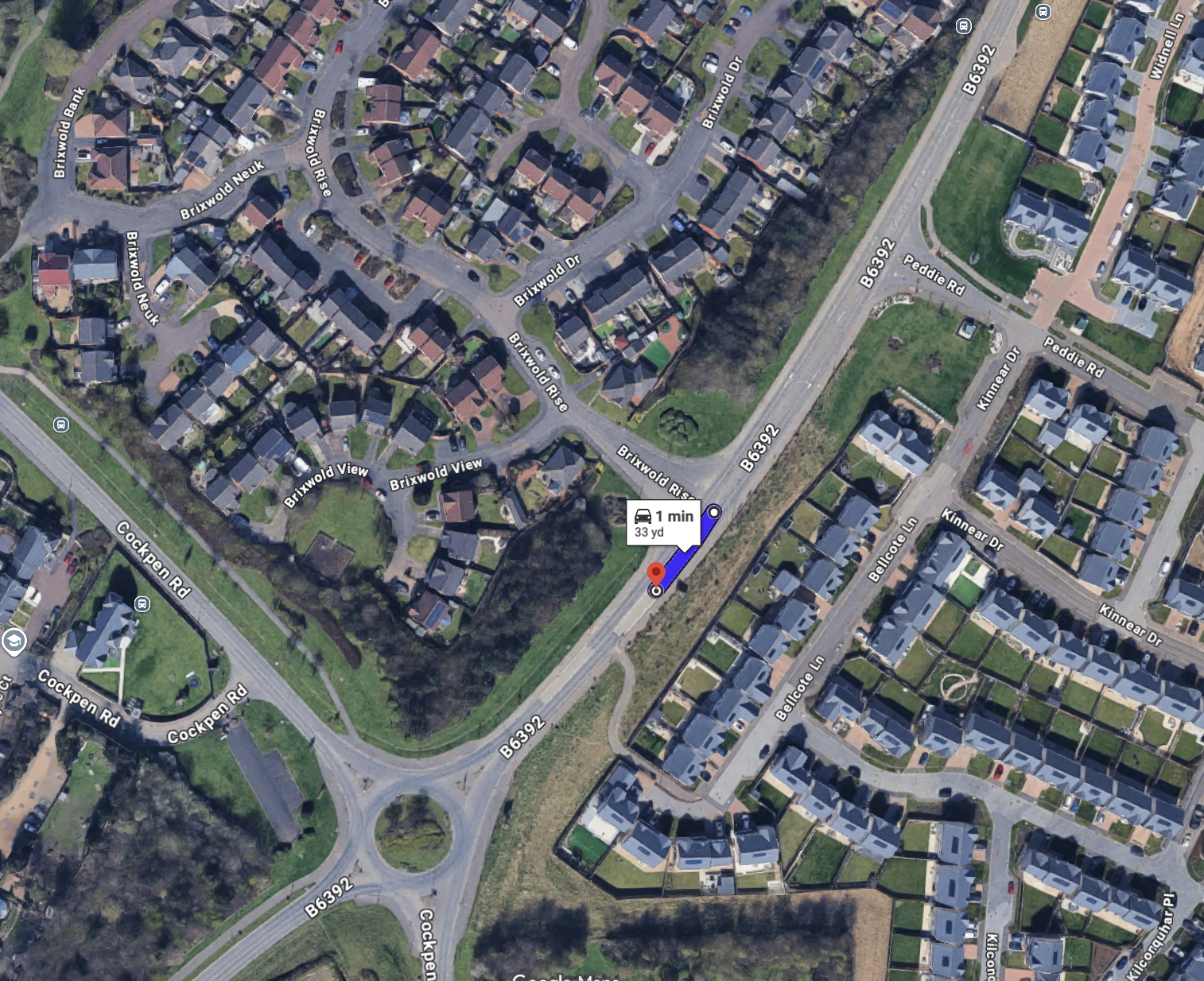
Motorcycle collision on the B6392 near Bonnyrigg
Ben was riding his BMW R1300 GS Adventure on the B6392 near Bonnyrigg.
Ahead of him was a Vauxhall Movano van.
As both vehicles approached the junction with Brixwold Rise, the van driver suddenly braked heavily after missing his turn.
Ben attempted to stop, but the braking occurred so late and so unexpectedly that a collision became unavoidable.
His motorcycle struck the rear of the van before falling onto its side.
Paramedics attended at the scene before Ben was taken by ambulance to the Royal Infirmary of Edinburgh.
Thankfully, he avoided any fractures, but he sustained multiple soft tissue injuries including injuries to his groin, lower abdomen, neck, thumbs and legs together with a significant haematoma to his shin which later became infected and required multiple courses of antibiotics.
Are motorcyclists always at fault in rear-end collisions?
Many people assume that if one vehicle collides with the rear of another, liability automatically rests with the rear driver.
That is not the law.
Every collision must be judged on its own facts.
Drivers owe duties not only to other drivers in front of them, but also to road users behind them. Sudden or unnecessary braking can create a significant hazard, particularly for vulnerable road users such as motorcyclists.
In this case there was no emerging hazard, no obstruction in the road and no obvious reason for the van to perform such a sudden braking manoeuvre.
The explanation became clear.
The driver had missed his turning.
Headcam footage provides crucial evidence
One feature of this case immediately caught our attention.
Ben's motorcycle was fitted with a forward-facing camera which recorded the collision.
Motorcycle camera footage can be invaluable. Rather than relying solely upon witness recollection months or years after an accident, footage allows solicitors to review events as they unfold and gain an immediate understanding of the circumstances leading to a collision.
In this case, the footage (see opposite) showed the van travelling beyond the junction before braking suddenly. It also demonstrated the limited time available for Ben to react and the absence of any obvious hazard ahead of the van.
Whilst camera footage is not essential to the success of every claim, it proved extremely helpful in allowing us to analyse the collision in detail from the outset. By reviewing the incident frame-by-frame, we were able to properly assess the actions of both road users and consider how the evidence fitted with the applicable legal principles.
Importantly, the case did not turn on the footage alone. Careful investigation of the surrounding circumstances, together with the available witness, police and liability evidence, enabled us to advance our client's position from an early stage. The footage nevertheless provided valuable support for our analysis and remained a significant evidential asset throughout the claim.
Challenging the Insurer's view on liability
Despite the available evidence, liability was disputed from the outset.
Even Ben's own insurers initially assumed the accident was his fault.
The third-party insurers adopted a similar position.
Rather than accepting that conclusion, we carried out our own investigation.
We obtained police information, reviewed the camera footage in detail and considered the relevant case law.

O’Donnell v RSA and rear-end motorcycle collisions
Particular attention was paid to the decision in O'Donnell v RSA, an important Scottish motorcycle case involving a motorcyclist who collided with the rear of a vehicle following an unexpected emergency stop.
Significantly, O'Donnell v RSA was a case prepared, litigated and successfully pursued by Motorcycle Law Scotland. It was a groundbreaking decision which challenged the assumption that a motorcyclist who collides with the rear of another vehicle must automatically be at fault.
The case demonstrates that the fact a motorcyclist has collided with the rear of another vehicle does not, by itself, determine liability. The circumstances leading to the collision and the actions of both road users must still be carefully considered.
It also demonstrates the difference that specialist motorcycle lawyers can make. Understanding motorcycle dynamics, rider behaviour and the circumstances in which a rider is required to react can be critical when challenging what might initially appear to be a straightforward liability case.
Court proceedings and a 100% settlement
As liability remained disputed, court proceedings were raised in the All-Scotland Sheriff Personal Injury Court.
The defenders maintained that Ben should have left sufficient distance to stop and argued that the accident was entirely his responsibility.
We disagreed.
Our position was that the van driver's decision to brake suddenly after overshooting a junction created a hazard which a reasonable rider could not have anticipated.
Importantly, we were prepared to substantiate that position with evidence.
Many claims settle because an insurer recognises the strength of the opposing case long before a proof hearing becomes necessary.
That is precisely why thorough preparation matters.
Following negotiations, the defenders agreed to settle the claim.
Ben received:
- Compensation for his injuries
- Compensation for damage to his riding kit
- Recovery of his motorcycle repair costs
- Compensation for services provided by his partner during his recovery
Most importantly, the settlement was achieved on a 100% basis, with no reduction for contributory negligence.
This is significant.
Even where liability arguments in rear-end motorcycle collisions succeed, insurers frequently seek to negotiate a percentage deduction.
In this case, no such deduction was applied.

Why specialist motorcycle solicitors matter
This case demonstrates why motorcyclists should be cautious about accepting an insurer's initial view of liability.
Had Ben simply accepted what he was being told immediately after the accident, he may have been left believing he had no claim at all.
Instead, a detailed review of the evidence revealed a very different picture.
Motorcycle collisions are rarely as straightforward as they first appear.
Understanding rider behaviour, advanced riding techniques, stopping distances, road positioning and motorcycle-specific case law can make a significant difference to the outcome of a claim.
The extra time invested in investigating liability allowed us to present the claim properly and ultimately secure a result that reflected the true circumstances of the collision.
Rear-end motorcycle collision? Don’t assume you are at fault
If you have been involved in a motorcycle accident and liability is being disputed, contact Motorcycle Law Scotland for specialist advice from solicitors who understand motorcycling.
Our Award Winning Team

Brenda Mitchell
Senior Partner
Brenda has been a Personal Injury Lawyer for over 38 years and for the last 20 years has specialised representing injured motorcyclists, cyclists and pedestrians.

Jodi Gordon
Partner
Jodi is a Partner at RTA Law LLP with 14+ years’ experience in catastrophic injury claims for vulnerable road users including cyclists and motorcyclists.

Thomas Mitchell
Partner
Thomas represents clients who have been involved in road traffic incidents and he specialises in representing vulnerable road users such as pedestrians, cyclists and motorcyclists.
Our Recent Case Studies

U-turn causes motorcycle collision
U-turn in stationary traffic causes motorcycle collision because driver fails to look.

Driver pulls out in front of motorcyclists
Drivers exiting junctions into the path of motorcyclists is a frequent cause of collisions. At or near junctions, motorcyclists perhaps need to alter their road position and be very aware.

Textbook rehab and a new KTM
Gordy suffered potentially life-changing injuries when a taxi drove in to him whilst stationary at a junction. However, early rehabilitation and steely determination on his part resulted in a brighter

‘Fatting up’ causes motorcycle to crash
Fatting-up of the road surface can cause a loss of friction which can affect a motorcycle, especially on a bend.
Is it worth 5 minutes of your time?
A quick phone call allows us to ask you a few questions about what happened to you and determine whether we can help.
This form collects your name and phone number so that we can contact you. Check out our Privacy Policy for more detail on how we store, process and protect your submitted data. If you choose not to consent, please use an alternative contact method shown on our Contact page.