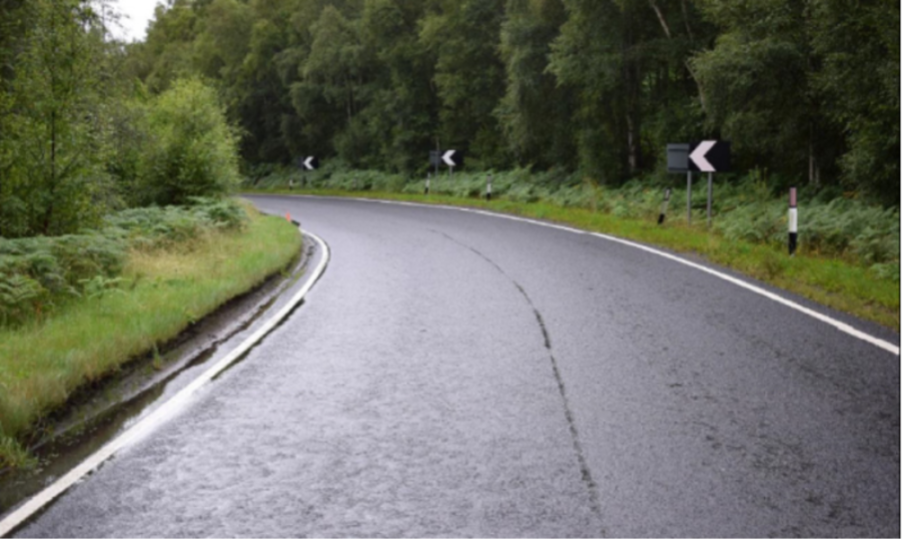
When experienced motorcyclist Bob set out for a ride through the Scottish Highlands with four colleagues, he had no idea that a vehicle emerging from a layby on a rural bend would leave him seriously injured or that the driver's insurer would later blame him for the collision.
Despite witness evidence supporting Bob's account, the insurer denied liability and alleged that he had been travelling too fast. Motorcycle Law Scotland took over his case, instructed an expert collision investigator and ultimately raised court proceedings before the other side finally conceded liability.
When the insurer still refused to accept responsibility, we raised court proceedings. It was only six weeks before the case was due to proceed to a Proof Hearing that the defenders finally conceded liability and made a satisfactory settlement proposal.
Motorcycle Accident on the A86 Near Loch Laggan
Bob, a train driver from Broughty Ferry, Dundee, is a highly experienced motorcyclist who has toured extensively throughout Europe.
He was riding his Suzuki Hayabusa through the Highlands with four colleagues, all of whom were also experienced motorcyclists.
Bob was leading the group west along the A86 from Laggan Wolftrax towards Spean Bridge, with Loch Laggan on his left.
As he approached an S-bend, which initially turned right and then left, Bob dropped down a gear. Before entering the left-hand bend, he positioned his motorcycle towards the right-hand side of his carriageway to maximise his view through the bend.
As he proceeded around it, however, he was suddenly confronted by a Toyota Hilux 4x4 towing a trailer.
The vehicle had been parked in a layby on Bob's left and was pulling out. Rather than joining Bob's carriageway, the driver was attempting to travel across the entire road towards the opposing carriageway.
The 4x4 and trailer were directly in Bob's path.
With virtually no time or space to react, Bob applied his brakes heavily. His motorcycle high-sided, catapulting him over the trailer before he landed heavily on the road.
Bob suffered fractures to his shoulder and ribs. His Suzuki Hayabusa was written off and his helmet and protective motorcycle clothing were damaged.
He was taken by ambulance to hospital in Fort William and, as a consequence of his injuries, was unable to work for three months.

You don't have to use your Insurer's panel solicitor
Following the collision, Bob contacted his motorcycle insurer and was referred to one of its panel solicitors to deal with his personal injury claim.
Like many people involved in a road traffic collision, Bob did not realise that he was entitled to choose his own solicitor. He believed he simply had to accept the solicitor to whom his insurer had referred him.
It was only after speaking to fellow motorcyclists that things changed.
They recommended that Bob contact Motorcycle Law Scotland and suggested that he should have specialist motorcycle lawyers dealing with his claim.
Bob researched Motorcycle Law Scotland, read about our experience of representing injured motorcyclists and looked through testimonials from previous clients. He then contacted us and asked us to take over his case.
His claim included compensation for his injuries, loss of earnings and the loss of his motorcycle, helmet and protective equipment.
Insurer blames the motorcyclist for the collision
When Motorcycle Law Scotland intimated Bob's claim to the insurer of the Toyota 4x4 driver, liability was denied.
Rather than accepting that their driver should not have attempted to cross the road from a layby situated close to a bend with restricted visibility, the insurer alleged that Bob had caused the collision by travelling too fast.
This presented an important issue.
Motorcyclists involved in collisions on rural bends can face allegations that they should have been travelling at a speed that allowed them to deal with whatever might reasonably be encountered around the bend.
One case frequently considered in this context is Arnot v Sprake (2001).
That case involved a collision between a motorcyclist and an agricultural vehicle on a left-hand bend. On appeal, the motorcyclist was held responsible. The court considered that the motorcyclist should have ridden in a manner that allowed him to deal safely with what he might encounter beyond his immediate view.
However, every motorcycle collision must be considered on its own facts and evidence.
The circumstances of Bob's collision were very different.
Specialist motorcycle case law supports Bob's claim
Motorcycle Law Scotland argued that the Toyota driver had been negligent in attempting to pull out of the layby and cross the road when the vehicle was positioned so close to a bend that the driver could not properly see approaching traffic.
Importantly, we were able to draw upon another Scottish motorcycle case involving similar issues: Adam Russell v NFU Mutual.
Motorcycle Law Scotland had successfully pursued that case to court in 2014.
In Russell, a vehicle emerged from a field entrance close to a bend and into the path of an approaching motorcyclist. The court found that the driver had failed to take reasonable precautions before emerging and there was insufficient evidence to establish that the motorcyclist's speed had contributed to the collision.
The driver was held responsible.
The comparison was important.
The mere fact that a motorcycle collision occurs on or close to a bend does not automatically establish that the motorcyclist was travelling too fast. The actions of the emerging driver, available sight-lines, vehicle positioning, speed, distances and the time available to react all require careful investigation.
That is why gathering the right evidence was crucial to Bob's claim.
Expert evidence helps prove the driver was negligent
We obtained witness statements from the motorcyclists who had been riding behind Bob.
They confirmed that the group had been travelling at a reasonable speed and within the speed limit before the collision.
Motorcycle Law Scotland also instructed an expert collision investigator to examine the circumstances of the accident.
The expert considered the road layout, the location of the layby, available sight-lines, the position of the Toyota Hilux and trailer and the physical evidence at the scene.
His findings were significant.
He concluded that, from the position in which the Toyota had been parked, its driver would not have been able to see approaching traffic properly because the layby was situated too close to the bend.
There were also other laybys in the vicinity which would have allowed the driver to stop on the appropriate side of the road without having to undertake the same manoeuvre across both carriageways.
The expert also considered the time it would have taken the 4x4 and trailer to move from a stationary position and cross the road, together with the motorcycle skid marks and Bob's likely speed.
His conclusion supported Bob's account: given the position of the Toyota and trailer, their proximity to the bend and the time taken to cross the road, Bob could not reasonably have avoided the collision.

Court proceedings raised at the All-Scotland Personal Injury Court
Despite the witness statements and expert evidence supporting Bob's case, the driver's insurer continued to refuse to accept liability.
Motorcycle Law Scotland therefore advised Bob that court proceedings should be raised.
His case was taken to the All-Scotland Sheriff Personal Injury Court in Edinburgh.
Even after proceedings had been raised and the supporting evidence lodged, the defenders continued to deny liability and made no acceptable offer of compensation.
We were prepared to take Bob's case to Proof.
A Pre-Trial Meeting took place in Edinburgh with the solicitors acting for the other side, but they remained unwilling to make a suitable settlement proposal.
The case continued towards a Proof Hearing.
Insurer finally concedes liability six weeks before proof
Only six weeks before the scheduled Proof Hearing, the defenders finally conceded liability.
A satisfactory settlement proposal followed.
For Bob, it brought to an end an 18-month battle during which he had faced allegations that he was responsible for a collision which our investigations and expert evidence demonstrated he could not reasonably have avoided.
The outcome also demonstrates why disputed motorcycle accident claims require careful investigation.
Road layout, sight-lines, motorcycle positioning, braking evidence, witness testimony and the actions of another driver can all be critical. An allegation that a motorcyclist was "going too fast" should not simply be accepted without examining the evidence.
It also demonstrates the importance of having solicitors who understand motorcycles, motorcycle dynamics and the case law surrounding motorcycle collisions.
Injured in a motorcycle accident in Scotland?
If you have been injured in a motorcycle collision, you do not have to use the solicitor recommended or appointed by your insurer.
You are entitled to choose the solicitor you want to represent you.
At Motorcycle Law Scotland, we specialise in representing injured motorcyclists. We understand that motorcycle accidents can involve complex questions of road positioning, visibility, speed, braking, vehicle dynamics and liability.
Where responsibility for a collision is disputed, we investigate the evidence and, where necessary, obtain specialist expert opinion to establish what happened.
If an insurer is blaming you for a motorcycle accident, that does not necessarily mean they are right.
Our Award Winning Team

Brenda Mitchell
Senior Partner
Brenda has been a Personal Injury Lawyer for over 38 years and for the last 20 years has specialised representing injured motorcyclists, cyclists and pedestrians.

Jodi Gordon
Partner
Jodi is a Partner at RTA Law LLP with 14+ years’ experience in catastrophic injury claims for vulnerable road users including cyclists and motorcyclists.

Thomas Mitchell
Partner
Thomas represents clients who have been involved in road traffic incidents and he specialises in representing vulnerable road users such as pedestrians, cyclists and motorcyclists.
Our Recent Case Studies

Van reverses into motorcyclist
Van reverses into motorcyclist at traffic lights and the driver apologises. However, the following day, he denies the incident occurred and instead blames the motorcyclist for riding into the back

Motorcycle accident on the A939
A motorcyclist was injured on the A939 after hitting excessive overbanding. Learn how we proved a road defect claim and secured a five-figure settlement.

Air ambulance saved James’ life
James was taken by air ambulance to the QEUH. He spent most of his 31 days there in the High Dependency Unit or Intensive Care.

Motorcyclist hits vehicle in front
Motorcyclist hit vehicle in front but there is NO presumption of negligence. Every case is fact sensitive.
Is it worth 5 minutes of your time?
A quick phone call allows us to ask you a few questions about what happened to you and determine whether we can help.
This form collects your name and phone number so that we can contact you. Check out our Privacy Policy for more detail on how we store, process and protect your submitted data. If you choose not to consent, please use an alternative contact method shown on our Contact page.