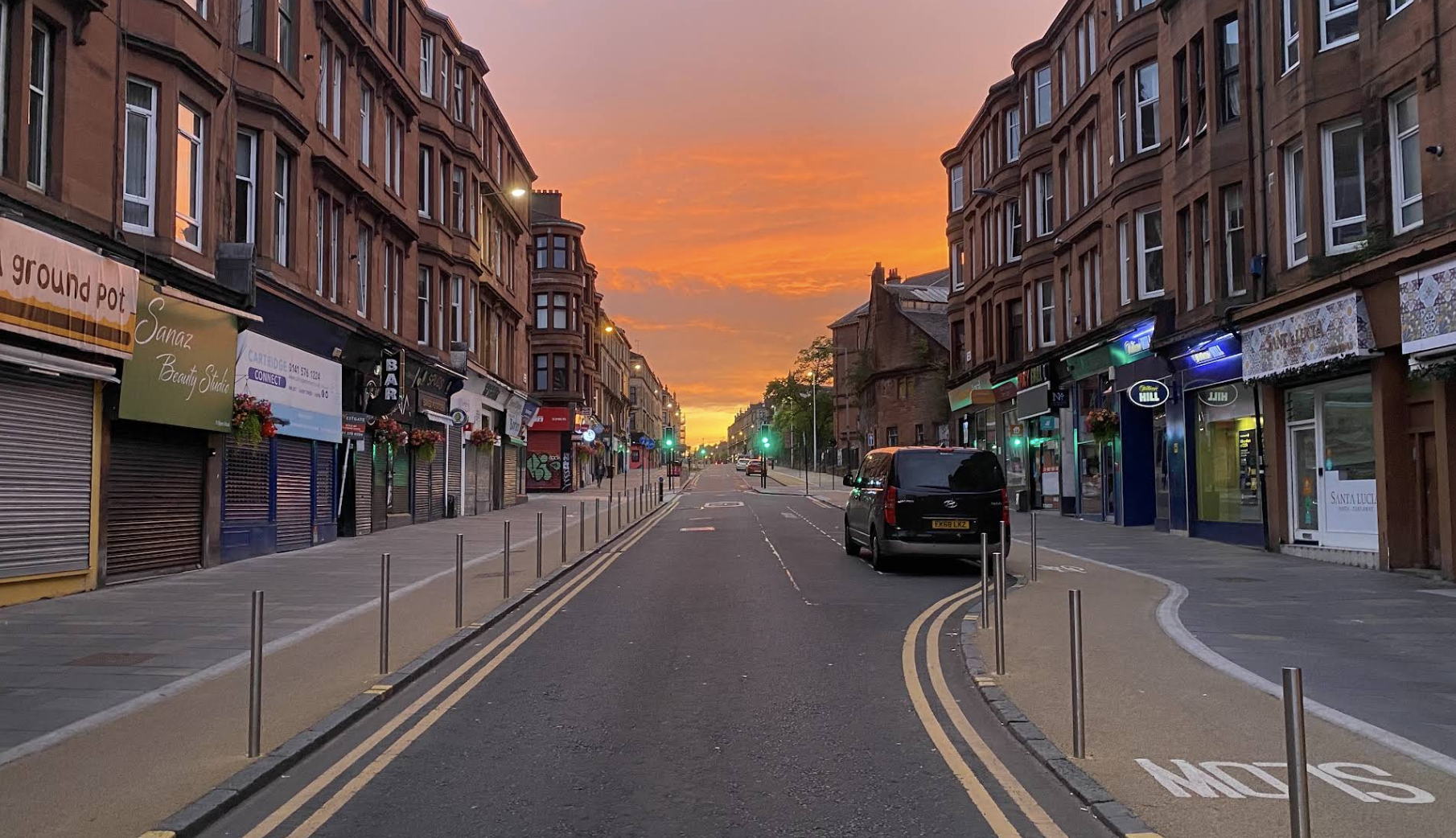
A driver pulls out into Scott's path
That was the situation facing Scott after he was knocked from his e-bike in Glasgow. The driver responsible was never identified, but with the help of Cycle Law Scotland, Scott was still able to access rehabilitation and recover more than £10,000 in compensation through the Motor Insurers’ Bureau (MIB).
Scott was cycling home from Finnieston on a January evening and was travelling north on Byres Road when he approached a junction. A vehicle was waiting to emerge into his path. It appeared that the driver had seen another vehicle indicating to turn left and mistakenly assumed it was safe to pull out. It wasn't.
The vehicle emerged into Scott's path and struck his electric bicycle, knocking him from his bike and causing him to land heavily on his right side. In the immediate aftermath of the collision, Scott was understandably shaken. He left the scene without obtaining the driver's name, registration number or insurance details.
He did, however, report the collision to Police Scotland. Officers subsequently reviewed available CCTV footage, but despite their enquiries, the vehicle and its driver could not be traced.
For Scott, that created an obvious question: if you don't know who the driver is, can you still make a claim?

Physical injuries and a loss of confidence on the road
Scott experienced considerable distress following the incident. He had difficulty sleeping, suffered recurring flashbacks and became fearful of being on the road.
For someone accustomed to travelling by bike, the loss of confidence was significant. Scott was temporarily unable to cycle and had to rely on other people for transport. He needed help not only with his physical recovery, but also to overcome the psychological impact of the collision and regain his confidence.

What happens when the driver cannot be traced?
Scott contacted Cycle Law Scotland because he was unsure whether anything could be done. The driver had disappeared, there were no insurance details and Police Scotland had been unable to identify the vehicle.
Fortunately, an unidentified driver does not necessarily mean the end of a compensation claim. The Motor Insurers' Bureau operates arrangements which can provide compensation to people injured as a result of the negligence of drivers who are either uninsured or cannot be traced. We were able to pursue Scott's case under the MIB Untraced Drivers' Agreement.
Importantly, the claim was about more than simply securing compensation at the end of the process. Scott needed rehabilitation to help him recover and return to normal life. His claim was accepted by the MIB and arrangements were made for him to receive physiotherapy for his physical injuries together with psychological therapy to address the distress, flashbacks and anxiety he had experienced following the collision.

Back on the road and more than £10,000 in compensation
Within eight months of the collision, Scott was well on the road to recovery and his claim was successfully settled for more than £10,000. Just as importantly, the rehabilitation provided during the claim helped him deal with both the physical and psychological consequences of being knocked from his bike.
Scott was delighted with the outcome and with the support he received throughout the process.
His case also illustrates an important point for other cyclists. If you’re involved in a collision, obtaining the driver's registration number, contact details and insurance information can be extremely important. If possible, details of witnesses and photographs or video of the vehicles and location should also be preserved.
But, collisions can be frightening and confusing. People do not always think clearly immediately afterwards, particularly when they have been injured or are in shock. If the driver leaves the scene, false details are provided, or, as happened to Scott, the driver simply cannot subsequently be identified, don't automatically assume that there is nothing you can do.
Report the collision to the police as soon as possible and seek specialist advice.
The Motor Insurers' Bureau exists to provide a route to compensation in certain cases involving uninsured and untraced drivers. At Cycle Law Scotland, we regularly deal with MIB claims and understand the agreements, procedures and timescales involved.
For Scott, the fact that the driver responsible was never traced did not prevent him from receiving the rehabilitation and compensation he needed to move forward and ultimately get back on two wheels.
Our Award Winning Team

Brenda Mitchell
Senior Partner
Brenda has been a Personal Injury Lawyer for over 38 years and for the last 20 years has specialised representing injured motorcyclists, cyclists and pedestrians.

Jodi Gordon
Partner
Jodi is a Partner at RTA Law LLP with 14+ years’ experience in catastrophic injury claims for vulnerable road users including cyclists and motorcyclists.

Thomas Mitchell
Partner
Thomas represents clients who have been involved in road traffic incidents and he specialises in representing vulnerable road users such as pedestrians, cyclists and motorcyclists.
Our Recent Case Studies
Cyclist injured at Glasgow roundabout wins claim despite insurer denying liability
A Glasgow cyclist suffered a fractured foot and had his brand-new Merida Reacto destroyed when a driver entered a roundabout and collided with him. Despite the driver's apology, her insurer
Pothole case Glasgow
An experienced cyclist suffered a serious wrist fracture after striking a pothole concealed beneath floodwater on a shared-use path at Hogganfield Loch, Glasgow. Cycle Law Scotland investigated the history of

Cyclist injured by German tourist on Scottish cycle path
Colin was cycling on National Cycle Route 75 when he was involved in a head-on collision with a German tourist who instinctively rode on the wrong side of the shared-use

Cyclist injured by hidden pothole secures full compensation
A keen cyclist suffered multiple injuries after hitting a pothole concealed beneath standing water near Kilmarnock. Despite attempts to reduce compensation, Cycle Law Scotland successfully secured a full settlement.
Is it worth 5 minutes of your time?
A quick phone call allows us to ask you a few questions about what happened to you and determine whether we can help.
This form collects your name and phone number so that we can contact you. Check out our Privacy Policy for more detail on how we store, process and protect your submitted data. If you choose not to consent, please use an alternative contact method shown on our Contact page.